Thursday, May 13, 2021

Things I Wish I Knew Before I Started Optometry School

In just a few weeks, I will officially become a second-year student! Crazy how quickly time has flown.  

Although looking back, the days seemed to never end. With constant schoolwork and studying, it still doesn’t feel real that I am so close to finishing off my first year. I am filled with so much excitement, but also a sprinkle of fear. It seems super overwhelming, but I already made it this far. With my study techniques and motivation, I am ready to tackle another year head-on. 

Getting adapted to my first year of graduate school took a lot of trial and error. I changed up my study techniques several times, but I think I finally found what works for me. 

So, here are a couple tips that I wish I knew before I started optometry school; 

1. Know your “Why” 

Having a strong purpose for going into a rigorous four-year program is a huge necessity. You will be making numerous personal sacrifices that require a lot of self-control. Many weekends may need to be spent buckling down on schoolwork or studying; grad school waits for no one, so you don’t want to be left behind. By having a strong reason to be there at the back of your mind at  all times, this helps to really bring you back and recognize that all that you are doing is worth it.  

2. Be open to change 

When all is said and done, everyone has the end goal of becoming an optometrist. But you must be aware that there are many paths to take even after you become an optometrist. Will you be in a private practice or corporate? Will you take a residency or become a fellow? Where do you want to practice, since every state has different regulations? Your goals will shift or become more and more specific as you continue through schooling, so you must not have tunnel vision. Be open to different paths and the possibilities are endless. Even as a first-year, the future I have imagined has changed so many times already. This is completely normal.  


3. Don’t compare yourself to others 

Everyone in your class will have the exact schedule as you, so you will all be experiencing similar stresses with exams and practicals at the same time. Don’t get obsessive over a grade or your GPA — at the end of the day, once you graduate you will ALL be doctors. Don’t be ashamed to reach out for help because the number of resources is endless (professors, mentors, tutors, peers). 


4. Buy a cute water bottle and take many breaks 

You can only get so far as your body and mind will take you. Don’t push yourself to put 110% of effort into your studies constantly without sprinkling in other activities to keep a balanced lifestyle. I found that having several water bottles and cute reusable straws really help remind me to stay hydrated. I am more of a night owl, so I like to sleep in but stay up late to finish up my tasks. Do what works for you and try to create a balanced routine. Find ways to refresh your mind, like taking a nap, watching a quick show, or even checking out a few TikToks. Make sure you’re eating properly, getting enough sleep, sticking to an exercise routine, and socializing with friends and family through video calls. Breaks will be your best friend to avoid burning out. You may think it is impossible to put all those aspects in, but just know, you do have time and you are doing just fine.  

5. Have a “to-do” list and try to complete it by the end of the week 

It is completely okay to fall behind with lectures for the week as you always have the weekend to catch up. If you find yourself falling more and more behind, make a study group with a  designated study spot. You may find that just being around productive people would be helpful.  Change up your study locations, have a tidy space, use new writing utensils — sometimes your mind just needs a change of pace to find the motivation to be productive again.  

6. You are not alone 

Even if you start off your experience virtually, you will find your pod. Don’t be hard on yourself if you are unable to find a group of friends from the get-go; everyone is very busy getting acclimated to the new environment. Just be yourself and have an open mind with everyone you meet. Reach out to anyone in every section for lab if you need a partner, as it is a great way to meet a wide range of people in your class. If anything, attend new clubs, join the mentorship program, or form other study groups—there are infinite amounts of chances to put yourself out there.  


It is important to note that these helped me personally, but everyone is different! Do not be afraid to reach out to upperclassmen, your professors, or even your fellow classmates. We are all in it together and everyone is there to help and support you. Always remember to take a  deep breath and get it done!


- Michelle is a first-year optometry student at Salus University


Learn More About Salus University 


Submit Your Student Story


Friday, April 16, 2021

Why I’m All for Taking a Gap Year Before Graduate School

The decision to take a gap year (or years) can be a very difficult decision to make. Upon receiving your bachelor’s degree, you have to make a very quick decision on whether to find a full-time job or continue onward to graduate school. Of course, there are other paths to take upon graduation, but with the mindset of continuing education like I was, here are my two cents on this situation.

After facing so many different viewpoints on why it is a good or bad idea to take a break, I’ve never once regretted my decision in taking a year off.


A lot of people tried to talk me out of taking a gap year 
– they would say things like:

  • “If you take a break now, you won’t be able to get used to being back in school again.”
  • “If you stop school now, you won’t want to go back.”
  • “If you don’t apply now, you are missing your chance.”
  • “If you don’t try now, it is not certain it will work out later.”

While it is easy to fall into the trap of agreeing with everything everyone else has to say, it is important to recognize that only you have the ability to do what you want with your life. Your life is precious, and making the decision that shapes your future should not be taken lightly. So instead of looking at the what if’s – start asking why not? 

You have been in school for the past 12 years, complying with the rules and regulations of the educational system – you never truly experienced the world to help guide you on what makes your life purposeful. Sure, you may have had part-time jobs, volunteered with different organizations, or held leadership positions with school clubs, but you were never able to give it 100% of your focus since you had to balance it with school.


Instead of enjoying the last few moments of college and your early twenties, and before being propelled into ‘adulthood’, you had to devote your latter years in undergrad to trying to find ways to impress your future graduate school. The effort in trying to be the most well-rounded student you can be should not cause you more distress than joy. Mental and physical health should be at the forefront when it comes to determining what you want to do for your future.

My biggest reason to take a gap year was that I wanted to finally take control of my own life. I wanted to take time to recognize that my hopes and dreams were truly my own and not what society had tried to force onto me. I wanted to make sure that I would enjoy the field that I plan to be in until I decide to retire and that I looked into all the possible paths as opposed to having tunnel vision. I wanted to make sure that my end goals would allow me to have genuine happiness and that the biggest reason for even doing it, is for me

If you want to take a year off, why not? Just make it purposeful


I loved every moment of my gap year. And here are some things that I was able to do in just a year:

  • I took on my first full-time job.
  • I established connections within the field of my dreams.
  • I shadowed professionals with more intention.
  • I experienced what it’s like to pay off student loans.
  • I spent time with my brothers and grew closer to them after being away for the past 4 years.
  • I reunited with my blind dog, Chubby, who is actually a major reason why I want to become an optometrist one day.
  • I attended family events/parties.
  • I discovered new hobbies.
  • I traveled.
  • I learned more about myself.
  • I found my purpose in life.
  • I was able to breathe.

All the sacrifices I made while being in school were no longer sacrifices I had to make. I became more comfortable with my independence and my future goals became very clear. I came out of my gap year with the mindset of going to graduate school and to thrive, not just survive – with the excitement of finally getting into my future career with no regrets that I made the wrong decision.

At least when it’s all said and done, I can look back and appreciate that taking one year off from school (especially in my early twenties) is the best decision I could make for myself. The amount of personal growth I achieved is something that I am very proud of.


- Michelle is a first-year optometry student at Salus University


Learn More About Salus University 


Submit Your Student Story

Friday, February 5, 2021

Learning How to Juggle in Graduate School

Hello, I am a second-year Optometry student at Salus University and I am going to show you how I juggle multiple workloads, extracurriculars, and hobbies while in graduate school, and hopefully inspire you to take your first step towards juggling too. I apologize if you were expecting an actual juggling how-to.


Starting with One

As a first-year, I focused just on tossing the ball labeled “academics.” Taking the time to understand how to toss this ball and catch it every time was vital. Entering graduate school and handling the difference in workload and pace was already difficult, so really spending the first semester focusing on and understanding what I personally needed to do to maintain my academic goals was very important. I adopted many new and refurbished old study habits that helped me get a good grasp on academics. I consistently relied on my weekly planner and Google Calendar to stay organized in classes and used a mixture of digital and handwritten notes depending on the course and content. I also realized that sitting down and creating Quizlets is very time-consuming, and many times if you just search the topic matter (i.e. Anatomy of the Cornea) in Quizlet, you will most likely find a Quizlet already created by another student. Of course, what worked for me will not work for everyone which is why I believe it is crucial to spend at least one semester focusing and understanding what you need to do to achieve your academic goals. If you do not master tossing and throwing one ball, it becomes very difficult juggling two, three, or more. Not to mention, many times we enter graduate school already juggling personal life, health, hobbies, social life, etc. so really knowing how academics will fit into your juggling act is key!


Now Add One More

In my second semester of first year I decided to sign up for a leadership position. I knew that being a student leader would help me with public speaking, time management, communication and learning to be resourceful. So, when the opportunity arose in December, I ran for the Assistant Treasurer position on the Salus University Student Council. This was my second “ball” that I added while already juggling the “academic ball.” Luckily, being in a leadership position is - in my humble opinion - easier to handle than academics because there are many people you can rely on or ask for help when you get lost or fall behind. I was very lucky to be working alongside an amazing team and with Ms. Monae Kelsey’s guidance, which easily allowed me to learn how to juggle two balls simultaneously. So, if you are at this point where you have gained a handle on academics and are struggling with the idea of whether or not to sign up for leadership, I say trust yourself and your abilities and go for it! It can seem intimidating, but you will not be alone in your position and there is help at every corner if you need it.


Now Add Another

I wanted to “add another ball” during the summer, but due to the pandemic many of us were forced to relearn how to juggle ball number one (academics) since we were now learning and testing virtually from the comfort of our home. So, I took the time over the summer to adjust to the new setting and waited until the fall semester of second year to sign up for yet another thing - this time it was a work position as an Ophthalmology Technician. There were many things to consider with this position: the commute, managing it with my academic schedule, and student council responsibilities. But, over time, this also became easy to juggle because I had already learned how to juggle two other things so this one came even easier than the last.


Continue Adding, While Being Realistic

I am now at the point where I have juggled three large and time-consuming activities alongside juggling life, staying social (virtually), exercising, cooking at home, reading, etc. Since I am in my second year spring semester, I am completing my optical clerkship and starting to prepare myself for clinic. Now the question is, should I keep adding more responsibilities to juggle or should I swap certain activities out for other beneficial experiences? It is important to remember that there are certain things you should not swap out for the sake of your health and well-being. Your sleep, healthy eating and exercise are crucial to how well you are able to manage multiple roles in graduate school. If your body is not healthy and you are tired and burnt out all the time, chances are you are not going to juggle multiple things, let alone just one. 

I hope this how-to and personal examples help illustrate how you can do more than just study while you are at Salus University, and maybe inspire you to take on juggling as well. Remember, you just have to start with one thing, and when you are comfortable you should trust yourself and add other things that will support your education and goals. If it becomes overwhelming, you can always go back to just juggling one - but you will not know what you are capable of unless you give it a try. Good luck with the upcoming semesters and stay safe!


- Jemi is a second-year optometry student at Salus University


Learn More About Salus University 


Submit Your Student Story


Friday, December 18, 2020

Using Art to Make Optometry School Memorable

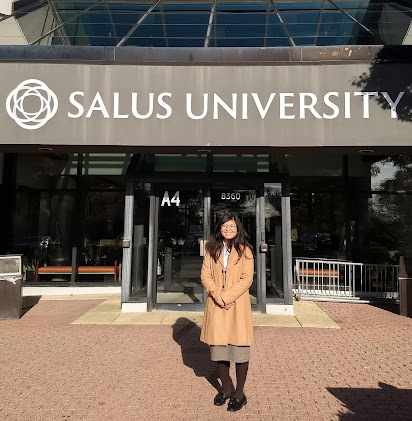
A year ago, on November 8th, 2019, I beamed into the camera as I stood in front of the doors to Salus University. I had just finished my first interview with the optometry program and it only took a few hours for me to realize that PCO was the one. The warm, welcoming environment of the admissions staff, the amazing Dean of PCO, and the fall colors made this Florida girl fall in love with the University and Pennsylvania. After careful consideration of my other options, PCO ultimately won my heart over as my next “home away from home.” I couldn’t wait for my next “eye-venture” to start.

Unfortunately, things did not happen as I had envisioned due to the pandemic.

The transition to professional school was rocky, at best, as opportunities to connect with my new peers were limited due to social distancing guidelines. I was worried that it would be a repeat of my first year of undergrad, where it took me an entire semester before I finally made my first close friend. Anxious about how my student experience would play out, I decided to make the most of any opportunity to make it memorable.

When my class found out our White Coat Ceremony would be held virtually (and only lasted ten minutes), I did not let my disappointment get the best of me. I turned to my art and I let my passion flow. Such an important milestone should be captured in my memory and if not a photograph, then why not a drawing? And so, I created a self- portrait with my virtual white coat to share that day. I shared it with my class and thus began my “Virtual White Coat Ceremony” series.


That wasn’t the only time art made an aspect of optometry school memorable. Classes were intense and the content difficult. It required creative solutions. I began using my art to test my understanding of the material. From little comics explaining various entrance exams to detailed illustrations showing the pathway of cranial nerves throughout the skull, art helped me feel more prepared for each exam. I happily shared such study resources with my peers, knowing I wasn’t the only one struggling with certain topics. Besides helping us in our personal studies, I hoped it would be a fun resource to teach others about optometry. I hope that there will be those who become inspired to become an eye doctor and that the community will appreciate the collaboration between the arts and the sciences.

Art created a platform for me to connect with others and share my own passions. Through the “Virtual White Coat Ceremony” series, I was given more opportunities to connect with classmates that I probably would not have met, since our class is divided into four sections. The study resources I share with my peers allowed us to engage with one another, to test each other’s knowledge, and just appreciate the sense of camaraderie we are able to form despite the circumstances. I personally feel like my art gave me a presence within my class, and I don’t feel like the wallflower I had been in undergrad. Art made the first semester of optometry school memorable and I cannot wait to see the next development of my student experience.


- Ariella is a first-year optometry student at Salus University


Learn More About Salus University 


Submit Your Student Story

Friday, October 2, 2020

Adapting to the "Unknown"

2020 most certainly was not the year any optometrist or optometry student expected. When the global pandemic first rampaged the country, we were in the height of our midterms and had an exam planned for the day school was to close. Since then, a lot of the pandemic was just “unknown.”

When the stay-at-home orders started, and all school and public buildings were closed, I had to make the adjustment to become an at-home student. As someone who loves to study at the library, in order to keep focusing on school and relaxing at home separate, this was a very difficult transition. However, it was a necessary one in order to do well during my spring and summer semesters. This adjustment, along with watching the news on the pandemic across the globe, studying for midterms, not knowing when we would return, or what the course of my curriculum would be like, caused my focus and motivation to decrease and my anxiety to increase.

As I was getting accustomed to studying from home, the professors were also going through their adjustment of moving everything online, and we as students just had to stay patient. In order to help ease the transition to virtual learning, several professors pre-recorded lectures in addition to holding collaborative sessions and online office hours, making sure that they were available to answer questions and help us through difficult material. One of my favorite aspects of the virtual environment was being able to attend an open forum with Dean Trego and faculty every week, where we discussed current events, their impact on our current learning environment, and how to move forward with our curriculum. I greatly appreciated having the chance for my voice to be heard and having such close communication with our administration during an unprecedented time.

Another aspect of virtual learning that required a major adjustment was taking exams online. Taking exams from home created an entirely new level of test anxiety, as being told things like you cannot put your hands on your face or if you look away from the camera you may be flagged was fairly daunting. When I first began taking the exams virtually, I would feel so incredibly nervous beforehand and then feel shaken down after every exam at the prospect that I would be flagged for something and be penalized. Additionally, as I was quarantining at home with my parents and grandparents, I had to adjust to there being other activities happening and background noise around me. Sometimes, they would forget I had an exam, which made me nervous that the Respondus Lockdown Browsers would pick up their conversations and flag me for that as well. This meant that exam time had to become quiet time for the entire household, which made me feel as though I was taking away from my family members’ freedom. However, as time went on and I took more exams, I became increasingly comfortable in the environment and my family worked with my schedule to help me in the best way they could to excel in my exams. 
What got me through these semesters was my support system. It was the professors who were willing to take a chance with virtual learning to help us understand the material. It was the Center for Professional and Personal Development who was able to schedule a virtual session with me and help me process the changes I was experiencing. It was being able to Zoom call and stay in touch with my friends and study groups. It was the virtual study sessions where my friends and I were able to work through PowerPoints and even create our own Kahoots to practice and study the material. It was my family who adjusted their schedules to accommodate my exams. It was everyone who helped me learn that while adjusting to new environments takes time, I can still be successful anywhere. 

Throughout this global pandemic, I had to do a lot of self-evaluating, make a lot of minor and major adjustments to my lifestyle, and take things one step at a time. However, through all of that, I grew as a student and as a person. I became stronger in the way I handled global news and the idea of the “unknown.” I learned that things will not always go as planned but you learn to adapt and make adjustments as you go. And, most importantly, I learned that you are not in this alone, and, at any point if you need help, you have a support system, even if it may be virtual. I am very grateful for the opportunities Salus University and PCO continue to give us students as we continue to learn and prosper in our careers.


- Ashka is an optometry student at Salus University


Learn More About Salus University 


Submit Your Student Story

Friday, September 18, 2020

Clinical Rotations During COVID

My name is Mauli Chothani and I am currently a second-year Occupational Therapy student. During our last semester, we have two clinical rotations, each 12 weeks long. My first clinical rotation was scheduled to be January 6 through March 27. We are given a one-week break, and my second clinical rotation was scheduled to be April 6 through July 26. 

When COVID-19 began in March, I had two more weeks left of my first clinical rotation in an outpatient pediatric setting. The facility had to quickly shut down and move to teletherapy. It was challenging treating kids virtually because there was a lot more parent involvement required, and kids usually don’t have the same equipment at home that is used in clinic.

My second clinical rotation is in an outpatient orthopedic setting, focusing on upper extremity injuries. Since COVID was at its peak around the time I was supposed to begin in April, the student clinical affiliation program was temporarily furloughed. Therefore, my graduation was also delayed. Fortunately, I was able to begin on July 13, I will be finishing up on October 2 and graduating that same month.

Although COVID-19 delayed my rotation schedule and delayed my graduation, I used the time off to my advantage. I picked up on new hobbies, caught up with family/friends via Zoom, and virtually taught children English. Having the break was much needed!


- Mauli is a second-year occupational therapy student at Salus University


Learn more about Salus University


Monday, August 17, 2020

Insights on the COVID-19 Pandemic

2020 has definitely been a year we can never forget. The COVID-19 pandemic has brought upon challenges we had never prepared for, becoming a time for us to function with strength, unity and caution. For me, this has been a difficult yet incredible learning opportunity! 

I graduated from my Bachelor of Science at the University of British Columbia in November 2019, and was excited to spend the next few months transitioning to optometry school. Little did I know, the world as we see it was about to change come March of this year. I had decided to take a trip to India this March, to visit family and reconnect with my cultural roots. My family and I left Vancouver, Canada just days before learning that COVID-19 was officially a pandemic. Just a week into our trip, what was supposed to be a relaxing time turned into a race to get early tickets back home before the Indian government enforced a complete nation-wide lockdown. We were one of the lucky ones to make it out the day before it started.


Arriving back in Vancouver after just 2 weeks, it seemed as though the world had completely changed. Streets were generally empty, household items were being sold out in all stores, and overall the world had become a fearful place. With the virus spreading and uncertainty for how schools, universities, and workplaces would function, many people around us including myself were starting to worry. Although I was not enrolled in any courses at that time, I began to wonder how long this pandemic would last, and what optometry school would look like for me. After some time, I started to notice some of the inspiring stories being shared in my community of people reaching out to those who were going through a tough time with the business closures and loss of jobs. People in my community, and in communities around the world were choosing to step up despite their own concerns and hardships. I realized that this pandemic would not be over until we tackle it by coming together and supporting one another. I decided to use this opportunity and organized a group of volunteers to start The Mask Project through my organization “Girls Empowered”, which I have been running for many years. We utilized our extra time indoors to make and donate cotton masks to women in need in shelters and resource centers around Vancouver. At a certain point during quarantine, I had felt as though I was serving no purpose, but channeling the time and resources I had to help others gave me a sense of strength. 

Another observation I have made during this pandemic is that despite all the technology and resources we may have in today’s time, proper leadership and the ability to listen as a population at large is critical in circumstances such as this pandemic. I have witnessed the direct effects of excellent leadership from the top doctor of BC, which helped us control the pandemic much better than any other province in Canada. I have also witnessed the negative effects from a lack of effective leadership which has led to an explosive rise of cases in other parts of the world. What has been the most shocking of all for me is to see the lack of unity we as people have, even when it comes to taking care of our own health. I have seen protests for wearing masks, hate crimes against certain races, and the refusal to accept protocols and public health measures. At a time like this, I feel that we need to be vigilant listeners and abide by the recommendations of health experts who are looking out for our health. We need to show compassion and kindness to those around us so that we can fight this challenge together. 

It is encouraging to see that despite some not cooperating, many choose to make the extra effort to social distance and protect one another. I am especially grateful to institutions such as Salus University, who are putting in so much effort to keep vital protocols in place so that we feel safe and stay healthy while adapting a hybrid model of study. As a new journey begins for my future classmates and I, I hope that we learn and grow as a strong, cohesive community to keep ourselves and those around us safe. I believe this pandemic has taught us the importance of listening, adapting and being patient while doing our part to keep our communities healthy. 


- Jaskirat is an optometry student at Salus University


Learn More About Salus University 


Submit Your Student Story